


DNA Pull-Down Service
Service Features
DNA Pull-Down technology is a powerful tool for studying DNA-protein interactions and regulation, helping to reveal important information about gene regulatory networks, signaling pathways, and disease mechanisms.
Service Introduction
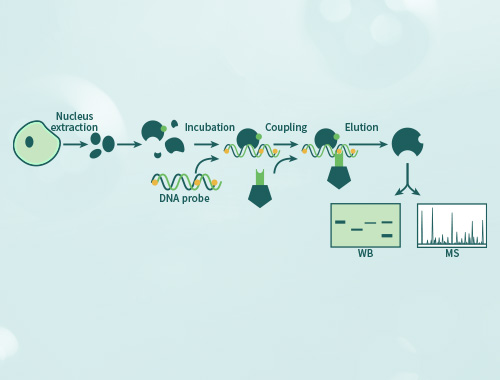
DNA Pull-Down is an analytical technique used to study protein-DNA interactions. Generally, this experiment first requires designing and preparing specific probes (primarily labeled with desthiobiotin) targeting the regulatory region of the gene of interest. Simultaneously, nuclear extracts are prepared. The probes and nuclear extracts are incubated together, allowing DNA-binding proteins to specifically bind to the target sequences. Then, the protein-DNA complexes are purified using streptavidin magnetic beads. Finally, the obtained proteins are identified using WB validation or mass spectrometry to determine protein types.
Service Advantages
- High Specificity: Highly specific enrichment of proteins interacting with target DNA sequences with low background interference.
- Quantitative Analysis: Enables quantitative analysis of DNA-protein interactions using fluorescent or radioactively labeled probes to measure binding strength and affinity.
- Suitable for High-Throughput Analysis: DNA Pull-Down technology allows high-throughput analysis, simultaneously studying multiple DNA-protein interactions, providing more comprehensive information and deeper insights.
- Low Sample Requirement: Requires only small amounts of sample for experiments, which is significant for research with limited or precious samples.
- Wide Applicability: Can be applied under various experimental conditions, including in vitro and in vivo studies, suitable for various biological systems and cell types. It can be used to study DNA-protein interactions in different biological processes such as gene regulation, DNA repair, chromatin structure and function. Whether studying basic biology or disease mechanisms, DNA Pull-Down technology has broad applicability.
Service Process
Our DNA Pull-Down service follows a rigorous 6-step process to ensure accurate and reliable results. Each step is carefully monitored and quality-controlled to maintain the highest standards in DNA-protein interaction research.
Customer Requirements
1. DNA sequence information or DNA overexpression plasmid
2. Cell samples
3. If WB detection is required, provide specific protein primary antibody
4. Sample requirements:
▶ Plasmid: at least 10μg
▶ Frozen cells: 2 vials or resuscitated cells: 2 flasks
▶ Animal or plant tissue: at least 500mg
▶ Cell pellet: at least 2×10^7 cells
Note: Except for resuscitated cells which can be shipped at ambient temperature, all other samples must be shipped on dry ice.
Service Description
| Service Name | Service Content | Deliverables & Standards | Service Cycle (Working Days) |
| DNA Pull-Down | Probe amplification and recovery | Amplification 2 times | 16 |
| Protein extraction + Coomassie staining | 1 sample | ||
| Pull-Down experiment | 2 enrichments: IgG and IP each once | ||
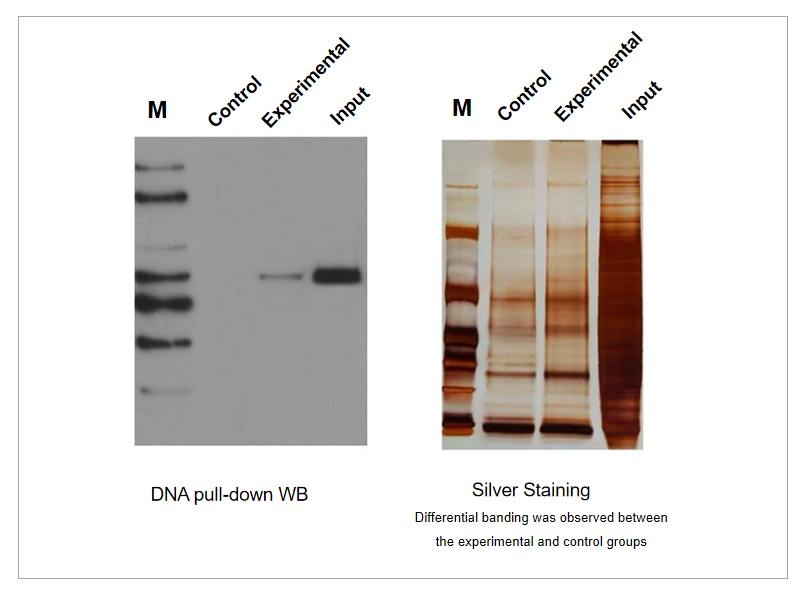
| SDS-PAGE Silver Staining | 3 gel lanes: IgG, IP, input | 4 | |
| Mass Spectrometry Identification of Interacting Proteins | MS identification: IgG and IP | 10-15 |
Case Studies
Ready to Start Your Molecular interaction Project?
Our expert team is ready to assist you with your molecular interaction research. Get in touch with us for a consultation or request a quote today.
Contact Our ExpertsQ&A
How to narrow down the probe sequence selection range?
Customer reviews
"Great service with stable experimental outcomes and low non-specific binding. The whole process is efficient, and finished reports are comprehensive, fully satisfying our gene binding protein exploration research demands."

Felix Ward
Biochemical Research Engineer
"Reliable DNA Pull-Down service with high enrichment efficiency and credible screening results. Standard experimental process ensures good repeatability. Detailed data reports strongly support our downstream target protein research."
Ivy Carter
Transcriptional Regulation Researcher
"The DNA Pull-Down Service provided by your team were outstanding. The experimental design was rigorous, the data were clear, reproducible, and publication-quality, and the background noise was extremely low."
Dr. Sarah Collins
Associate Professor