


Surface Plasmon Resonance (SPR) Service
Service Features
SPR technology is the "gold standard" for analyzing biomolecular interactions. Its unique real-time, label-free, and highly sensitive analytical capabilities provide precise binding kinetics and affinity data, widely used in fundamental biological mechanism research, antibody characterization, drug screening, and other critical areas, offering essential experimental evidence for scientific exploration and drug development decisions.
Service Introduction
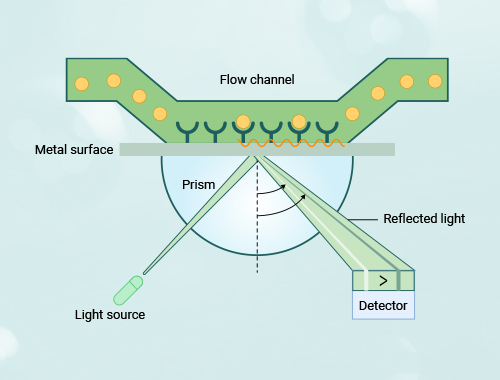
Surface Plasmon Resonance (SPR) technology is an optical-based, label-free novel detection and analysis technology that can be used for real-time detection of binding interactions between two or more molecules. Its instrument platform offers high throughput, flexibility, and sensitivity, enabling researchers to characterize biomolecular interactions in binding studies. It is widely applicable to various molecules such as ions, molecular fragments, small molecules, proteins, viruses, etc., and can provide biophysical data such as affinity, kinetics, and thermodynamics.
Service Advantages
- Label-Free Detection: No need for fluorescent or radioactive labeling of analytes, maintaining the natural state of molecules.
- Real-Time Dynamic Monitoring: Directly and real-time observation of the entire process of molecular binding and dissociation.
- High Sensitivity: Can detect samples at very low concentrations (picomolar or even femtomolar levels).
- Non-Destructive: Typically non-destructive to samples, allowing for sample recovery.
- High Throughput: Modern SPR instruments support multi-channel parallel detection, improving efficiency.
- Kinetics: Directly obtain association and dissociation rate constants of molecular interactions.
- Accurate Quantification: Direct measurement of mass changes caused by molecular binding, providing absolute quantitative binding information.
Service Description
Application Scope
• Biomedical Field: Widely used for protein-protein, antibody-antigen, protein-small molecule, antibody-peptide, protein-DNA, DNA-DNA, protein-nanomaterial interactions, etc. At least one sample must be a protein, and both samples require high purity.
• Drug Discovery Field: Suitable for drug screening, drug-target interaction studies, and pharmacokinetic research. It can rapidly screen lead compounds by monitoring the affinity between compounds and targets, and provide effective kinetic data for structure-activity relationships.
• Other Fields: Also applied in surface plasmon resonance sensors, scanning near-field optical microscopy, thin-film optics and thickness measurement, holographic imaging, precision angle measurement, etc.
| Item | Kinetics |
Protein Requirement (Minimum) |
Small Molecule Requirement | Nucleic Acid Sample Amount | Provided Parameters | Application Scope | Sample Preparation & Shipping |
| MST | √ |
50 μg |
1mg | 5OD | Binding constant KD | Used to detect interactions between protein/nucleic acid and another substance and calculate molar concentration | Protein recommended as dry powder, small molecules recommended as powder, shipped on dry ice in sufficient quantity. Due to preservation difficulty, protein is generally not recommended for return shipping. |
| SPR | √ |
50 μg |
1mg | 5OD | Binding constant KD, Association rate constant Ka, Dissociation rate constant Kd | Used to detect interactions between protein/nucleic acid and another substance and calculate molar concentration | Protein recommended as dry powder, small molecules recommended as powder, shipped on dry ice in sufficient quantity. Due to preservation difficulty, protein is generally not recommended for return shipping. |
Technical Comparison
SPR: Traditional technology, most widely used, highest acceptance and literature support.
MST: Preferred for detecting weaker binding interactions, or as supplementary data detection, but provides only affinity data.
Ready to Start Your Molecular interaction Project?
Our expert team is ready to assist you with your molecular interaction research. Get in touch with us for a consultation or request a quote today.
Contact Our ExpertsCustomer reviews
"Reliable SPR detection with accurate experimental data and standardized procedures. Fast service progress and detailed analysis reports fully satisfy our scientific research and project testing needs."

Eric Morris
Drug Development Researcher
"The SPR service is very professional. It accurately detects molecular binding affinity and kinetics data. Stable signals and high repeatability effectively support our ligand-target interaction research perfectly."
Irene Brooks
Molecular Interaction Researcher
"GeneCreate's Molecular Interaction Platform was instrumental in deciphering a novel signaling pathway by providing critical data, which significantly accelerated our drug target validation process."
Dr. Liu
Professor, School of Biological Sciences