


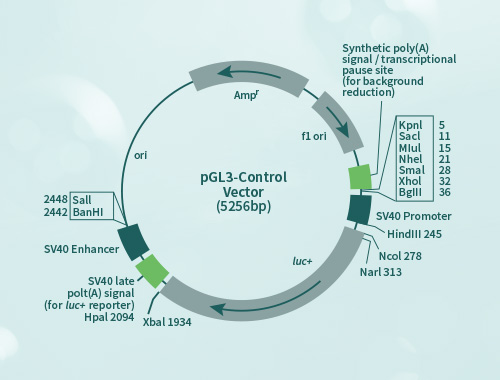
Dual-Luciferase Reporter Assay System
Service Features
The core features of the dual-luciferase assay lie in its high sensitivity, precision of internal reference calibration, and flexible application scenarios, which can significantly enhance research efficiency and reduce experimental bias, making it one of the "gold standards" in molecular mechanism research.
Service Introduction
Dual-luciferase detection is a very important experimental method in transcriptional regulation research, mainly used for verification of interactions between promoters and transcription factors, as well as miRNAs and their target genes.
In the dual-luciferase assay, firefly luciferase is used as the experimental reporter gene, and Renilla luciferase is used as the control reporter gene. The experimental reporter gene is used to test gene expression under experimental conditions, while the control reporter gene serves as an internal control.
Luciferin is used as a substrate to detect firefly luciferase activity. Luciferase can catalyze luciferin, and bioluminescence is emitted during the oxidation of luciferin, which is then measured by a chemiluminescence instrument.
Service Advantages
- High sensitivity: 1000 times more sensitive than Western blot
- No reporter genes: No endogenous expression of reporter genes in plants and mammals
- Unaffected by substances: Luciferase detection is not affected by other intracellular substances
- Convenient detection/wide range: Wide detection range, greater than 7 orders of magnitude
Service Process
Our dual-luciferase assay service follows a comprehensive 6-step process to ensure accurate and reliable results for your gene regulation studies. Each step is carefully monitored and quality-controlled to maintain the highest standards in molecular interaction research.
Customer Requirements
Gene template, detailed transcription factor, target gene, or microRNA information needs to be provided.
Experimental cells: If no special requirements, GeneCreate defaults to using 293T cells, so no need to provide.
Service Description
|
Service Name |
Service Content | Deliverables & Standards | Service Cycle (Working Days) |
| Animal Dual-Luciferase |
Target Gene Synthesis |
For sequences below 400bp; >400bp see additional items | 20 |
|
Plasmid Extraction |
Return of remaining target gene plasmid | ||
|
Mimics Synthesis |
Note: Only for miRNA verification | ||
|
Cell Transfection |
Default 4 groups, 5 replicates each | ||
|
Dual-Luciferase Detection |
Final report and raw data delivery | ||
|
Plant Dual-Luciferase (Quantitative) |
Plasmid Extraction |
Return of remaining target gene plasmid | 20 |
|
Tobacco Injection |
4 groups per leaf, 5 replicates each | ||
|
Dual-Luciferase Detection |
Final report and raw data delivery | ||
|
Plant Dual-Luciferase (Qualitative + Quantitative) |
Plasmid Extraction |
Return of remaining target gene plasmid | 20 |
|
Tobacco Injection |
4 groups per leaf, 5 replicates each | ||
|
Photography |
Delivery of 3 leaf photos | ||
|
Dual-Luciferase Detection |
Final report and raw data delivery |
Case Studies
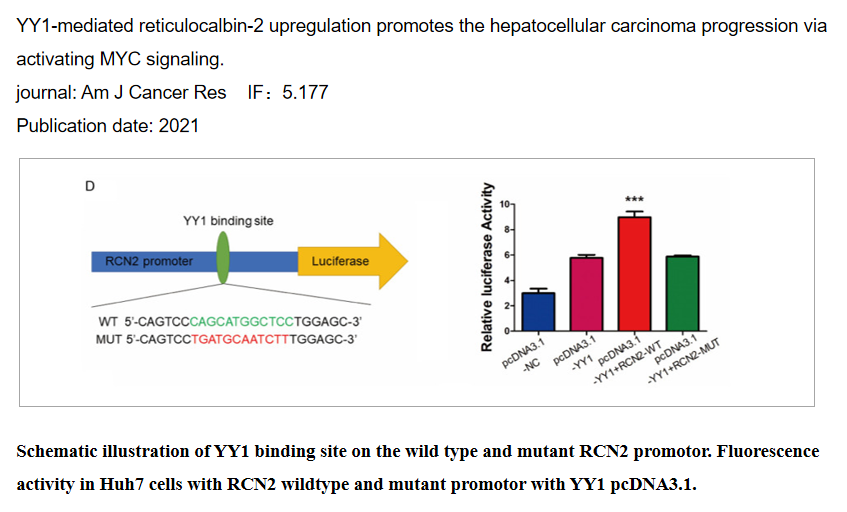
Ready to Start Your Molecular interaction Project?
Our expert team is ready to assist you with your molecular interaction research. Get in touch with us for a consultation or request a quote today.
Contact Our ExpertsQ&A
What are the main applications of Luciferase Reporter Gene Assays?
How does the relative activity of Renilla Luciferase compare to Firefly Luciferase?
Customer reviews
"Dual-Luciferase Reporter Assay System shows outstanding advantages. Compatible with mainstream luminometers. The test results are stable with good batch consistency, which fully meets the strict data standard requirements of pharmaceutical research. "

Linda Wilson
Pharmaceutical R&D Experiment Engineer
"The internal normalization design greatly reduces experimental errors and ensures highly repeatable and accurate data. The reagents are easy to prepare and operate, perfectly suitable for high-throughput reporter gene detection. "
Michael Carter
Senior Molecular Biology Researcher
"This Dual-Luciferase Reporter Assay System delivers consistently stable signals and excellent reproducibility across multiple cell lines. The protocol is straightforward, and we obtained publishable-quality data quickly."
Dr. Emily Carter
Senior Research Scientist , Stanford University