


Bimolecular Fluorescence Complementation (BiFC) Service
Service Features
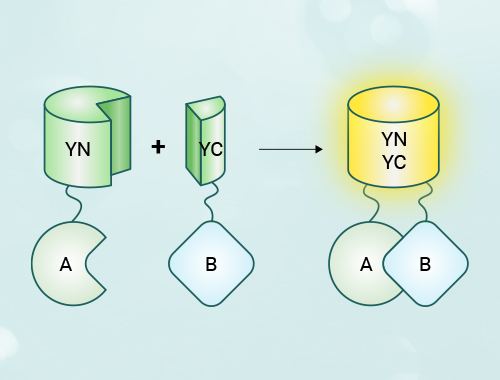
Bimolecular Fluorescence Complementation (BiFC) technology utilizes two proteins with interaction affinity to bring together complementary fragments of a fluorescent protein, forming a complete fluorescent protein that characterizes the occurrence and spatial location of protein interactions.
Service Introduction
Bimolecular Fluorescence Complementation (BiFC) technology is based on the principle of protein fragment complementation and is used to study protein-protein interactions. The principle involves splitting a fluorescent protein (such as Green Fluorescent Protein GFP, Yellow Fluorescent Protein YFP, etc.) into two complementary but non-fluorescent fragments (such as N-terminal and C-terminal fragments), which are then fused to the proteins of interest (Protein A and Protein B) for co-expression in cells. When Protein A interacts with Protein B within the cell, the fluorescent protein fragments are brought into proximity and reassemble into a complete fluorescent protein, generating a fluorescent signal that can be visualized under a microscope, providing direct evidence of protein interaction.
Service Advantages
- Detection in living cells: Allows direct observation of protein interactions in physiological conditions, preserving spatiotemporal dynamic information.
- High specificity: Fluorescent signals only appear when target proteins interact, reducing false positives and improving detection specificity.
- Detection of weak or transient interactions: Sensitive to low-affinity, brief interactions, capable of revealing interactions difficult to detect by traditional methods.
- Visualization of subcellular localization: Simultaneously reveals the subcellular localization of the interaction. Applicable to various biological systems: Can be used in mammalian cells, plant cells, yeast, and other model organisms.
Service Process
Our BiFC service follows a rigorous 5-step process to ensure accurate and reliable results for protein interaction studies in living cells.
Customer Requirements
1. Protein sequence information
2. Sample requirements:
▶ Customer provides vector/template: Must provide vector MCS sequencing report/template sequencing results. If no sequencing report is provided, additional sequencing fees will be charged, and GeneCreate will perform the sequencing.
▶ Customer provides bacterial culture: Bacterial culture volume should be ≥0.5mL. Glycerol stocks stored for more than one year need to be activated before submission.
▶ Customer provides plasmid: Plasmid quantity ≥5μg.
▶ Bacterial cultures and liquid plasmids must be shipped with ice packs.
Service Description
| Service Name |
Service Content |
Deliverables & Standards | Service Cycle (Working Days) |
| Tobacco Leaf BiFC | Plasmid Extraction | Return of remaining target gene plasmid | 20 |
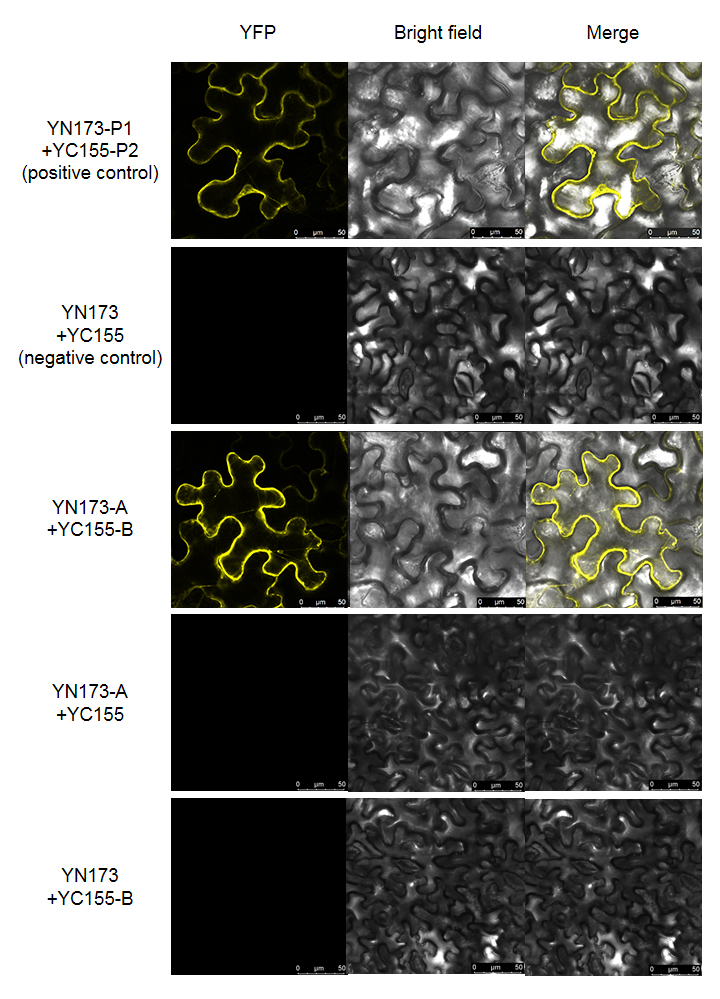
| Tobacco Infiltration | Default: 1 positive control, 3 negative controls, 1 experimental group (5 groups total) | ||
| Image Acquisition |
1 field of view for each negative and positive control, 5 fields of view for each of the 2 single-molecule negative controls and 1 experimental group. Each field includes YFP, Bright field, and Merge images (3 images per field). |
||
| 293T Cell BiFC | Endotoxin-free Plasmid Extraction | Return of remaining target gene plasmid | 20 |
| 293T Cell Transfection | Default: 1 positive control, 3 negative controls, 1 experimental group (5 groups total) | ||
| Image Acquisition | 1 field of view for each negative and positive control, 5 fields of view for each of the 2 single-molecule negative controls and 1 experimental group. Each field includes YFP, DAPI, and Merge images (3 images per field). |
1. The experimental system can be chosen based on the sample species type, either in 293T cells or tobacco leaves. Using tobacco as an example, the grouping is as shown in the table.
2. Criteria for successful experiment: Positive control shows fluorescence, and negative control shows no fluorescence.
3. Under the condition that positive and negative controls are normal, if fluorescence is detected in the experimental group, it indicates interaction between the two proteins; otherwise, it indicates no interaction.
Case Studies
Ready to Start Your Molecular interaction Project?
Our expert team is ready to assist you with your molecular interaction research. Get in touch with us for a consultation or request a quote today.
Contact Our ExpertsCustomer reviews
"Satisfied with this reliable BiFC testing service. Stable experimental effect and detailed result reports are provided. Efficient progress fully meets our cellular interaction verification research needs."

Miles Cooper
Biomedical Research Scientist
"Professional BiFC service with clear fluorescence signals and intuitive detection results. Standard experiment flow ensures high accuracy and repeatability, perfectly supporting in vivo protein interaction research."
Clara Fisher
Cell Biology Researcher
"GeneCreate's precision gene synthesis services were instrumental in our research breakthrough. Their attention to detail and quick turnaround made all the difference."
Dr.Elena Rodriguez
R&D Director, BioTherapeutics Inc.