


Electrophoretic Mobility Shift Assay (EMSA) Service
Service Features
GeneCreate provides professional EMSA detection services to help you detect DNA-binding proteins, RNA-binding proteins, and specific protein-nucleic acid interactions with high accuracy and reliability.
Service Introduction
Electrophoretic Mobility Shift Assay (EMSA) is a technique used to detect protein-nucleic acid interactions, providing qualitative and quantitative analysis. It has been widely used to study DNA-binding proteins and their interactions with specific DNA sequences, making it a classical method for transcription factor research.
Validation EMSA
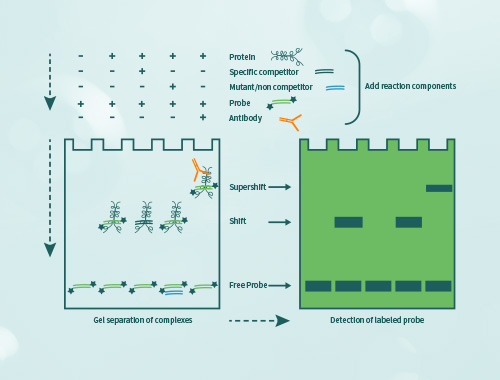
Used to verify whether the probe contains binding sites for proteins. By mutating the binding sites and using the mutant probe as a control, if the wild-type probe shows a shifted band while the mutant probe does not, it indicates that the probe contains protein-binding sites.
Competition EMSA
The probe sequence remains unchanged, and unlabeled probes are called cold probes. Cold probes compete with labeled probes for protein binding, but cold probes do not produce visible shifted bands. Using cold probes as controls, if the labeled probe shows a shifted band while the cold probe's band weakens or disappears, it eliminates false-positive interference and increases experimental accuracy.
Supershift EMSA
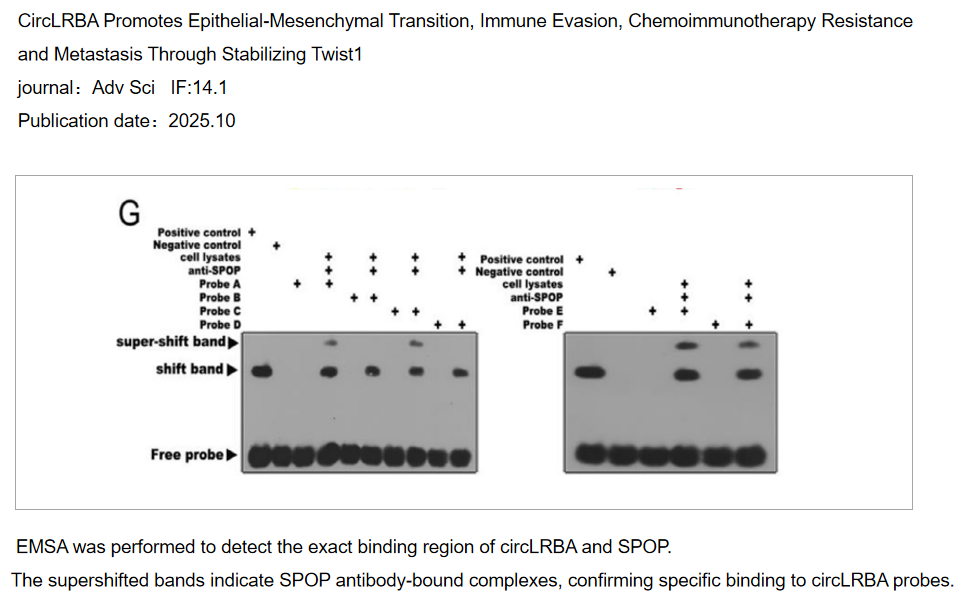
Uses specific antibodies against the target protein. The protein-probe complex is recognized and bound by the antibody, forming a ternary complex that migrates faster in gel electrophoresis, appearing as a supershifted band above the protein-probe complex, confirming the specific binding between the probe and the target protein.
Service Advantages
- Direct detection of protein-nucleic acid interactions, providing qualitative and quantitative information.
- Can be used to study various types of interactions, such as specific binding, non-specific binding, and sequence specificity.
- Simple technology with relatively easy experimental operation.
- Can be adapted to different experimental needs using various labeling methods and detection techniques.
Service Process
Our EMSA service follows a rigorous 8-step process to ensure accurate and reliable results. Each step is carefully monitored and quality-controlled to maintain the highest standards in protein-nucleic acid interaction research.
Customer Requirements
1. Cells for nuclear protein extraction: >10^7 cells, animal tissue not less than 400 mg, plant tissue not less than 2 g. We recommend customers to express recombinant proteins at GeneCreate.
2. Probe sequence.
3. If using specific antibodies for binding proteins: more than 50 μL of antibody with concentration greater than 0.5 mg/mL.
Service Description
| Service Name |
Service Content |
Deliverables & Standards | Service Cycle (Working Days) |
| DNA Probe Labeling |
Probe labeling and synthesis (≤59bp) |
Probe annealing at least once (1 set of probes annealed once) | 7-10 |
|
Probe labeling and synthesis (60bp-300bp) |
Protein incubation at least once | 12-16 | |
| RNA Probe Labeling |
Probe labeling and synthesis (<60bp) |
Probe labeling | 7-10 |
| EMSA | EMSA | 10 lanes (including negative and positive controls) |
10 |
Special Notes:
▶ EMSA can also be used to study RNA-binding proteins and their interactions with related RNA sequences.
▶ If supershift is required, IP-grade antibodies need to be provided.
▶ EMSA and yeast one-hybrid can jointly validate the same research question.
Case Studies
Ready to Start Your Molecular interaction Project?
Our expert team is ready to assist you with your molecular interaction research. Get in touch with us for a consultation or request a quote today.
Contact Our ExpertsQ&A
During PAGE electrophoresis, why don't Oligo DNAs of exactly the same length migrate to the same position?
Can the synthesized DNA/RNA product quantity be determined based on the brightness of the electrophoresis band?
Customer reviews
"Outstanding EMSA service with clear shift bands and reliable experimental data. Strict operation ensures high repeatability. Detailed reports and efficient progress perfectly support our DNA-protein interaction study."

Amelia Gray
Molecular Genetic Researcher
"Satisfied with this EMSA detection service. High experiment success rate, clear electrophoresis bands and reliable test data. Efficient service and timely feedback fully meet our research requirements."
Ethan Hall
Biomedical Research Associate
"The EMSA service is highly professional. Stable binding band results and accurate data are obtained. Standard experimental procedures and detailed analysis reports efficiently support our nucleic acid-protein interaction research."
Chloe Young
Gene Regulation Researcher