


In tumor biology research, elucidating the regulatory mechanism of transcription factors on downstream target genes is the core link in understanding tumor development and treatment resistance. The Dual-Luciferase Reporter Assay, as the "gold standard" technology for verifying the interaction between transcription factors and promoters, frequently appears in high-impact research.
Recently, the team led by Professor Hang Yin from the Affiliated Tumor Hospital of Harbin Medical University published important research results in the international authoritative journal 《Cancer Research》 (IF = 16.6), revealing for the first time a new mechanism by which PRMT3 drives radiotherapy resistance and immunosuppression in non-small cell lung cancer through the TFAP2A-IDO1 axis. The key dual-luciferase experiment in this study was completed by GeneCreate Biotechnology, fully demonstrating GeneCreate's technical strength in the field of molecular interaction verification.

So far, GeneCreate has helped customers publish more than 2000 academic papers, with a total impact factor exceeding 12000 points, and has been frequently published in international top journals such as Molecular Cancer, Nature Microbiology, and Drug Resistance Updates.
Among them, the services related to the Dual-Luciferase Reporter Assay have been cited in more than 200 SCI papers, becoming the core technical platform to help customers reveal gene regulatory mechanisms.
01 Research Background: Clinical Dilemma of Radiotherapy Resistance in NSCLC
Non-small cell lung cancer (NSCLC) is the main type of lung cancer, and radiotherapy is one of its important treatment methods. However, radiotherapy resistance is the main cause of treatment failure and tumor recurrence. Metabolic reprogramming and immune microenvironment disorder are considered two core driving forces of tumor drug resistance.
The IDO1-mediated tryptophan-kynurenine (Kyn) metabolic pathway is abnormally activated in various tumors, not only promoting the survival of tumor cells, but also inhibiting the function of CD8+ T cells by producing immunosuppressive metabolite Kyn. However, the transcriptional regulatory mechanism of abnormally high expression of IDO1 in tumors is still unclear.
02 Core finding: Revelation of the PRMT3-TFAP2A-IDO1-Kyn regulatory axis
Through systematic screening, the research team first discovered that PRMT3 is a key factor regulating the radiosensitivity of NSCLC. The study revealed a complete molecular pathway:
High expression of PRMT3 drives radioresistance: In the tumor tissues of NSCLC patients who are unresponsive to radiotherapy, PRMT3 is significantly highly expressed and is associated with poor prognosis of the patients.
PRMT3 methylates TFAP2A: As a protein arginine methyltransferase, PRMT3 methylates the R363 site of the transcription factor TFAP2A. This modification prolongs the half-life ofTFAP2A, promotes its nuclear localization and dimerization.
TFAP2A activates IDO1 transcription: Methylated TFAP2A enhances its binding ability to the IDO1 promoter, thereby upregulating IDO1 expression and driving enhanced Kyn metabolism.
The Kyn-AhR axis mediates immunosuppression: Increased Kyn activates the aryl hydrocarbon receptor in CD8+ T cells, leading to T cell exhaustion and functional inhibition, forming a vicious cycle of "metabolic disorder-immunosuppression"
03 Technical focus: The key verification role of the dual-luciferase reporter gene experiment
In this study, to prove that TFAP2A directly binds to and activates the IDO1 promoter, the authors used the dual-luciferase reporter gene detection system. This is the core experimental method for verifying the direct interaction between transcription factors and the promoters of target genes.
Experimental design idea
|
Experimental group |
Vector construction |
Co-transfection |
Expected results |
|
Experimental group 1 |
IDO1 promoter-WT + luciferase reporter vector |
TFAP2A overexpression vector |
Luciferase activity was significantly increased |
|
Experimental group 2 |
IDO1 promoter-Mut (mutation of TFAP2A binding site) +luciferase reporter vector |
TFAP2A overexpression vector |
Luciferase activity did not change |
Result interpretation
When TFAP2A was co-transfected with the wild-type IDO1 promoter, the luciferase activity was significantly increased, indicating that TFAP2A could activate the transcriptional activity of the IDO1 promoter.
After the TFAP2A binding site was mutated, TFAP2A could no longer enhance the luciferase activity, confirming that the direct transcriptional regulation ofTFAP2A on IDO1 depends on a specific binding sequence.
This result provides key evidence for the complete pathway of "PRMT3→TFAP2A methylation→IDO1 transcriptional upregulation", and is also one of the important supporting data for this study.
04 Main application scenario
|
Application scenarios |
Explanation |
|
Verification of Transcription Factor-Promoter Interaction |
Construct the promoter sequence upstream of Luc, co-transfect with the transcription factor, and detect the change in Luc activity |
|
Verification of miRNA-Target Gene |
Construct the 3'UTR of the target gene downstream of Luc,co-transfect with miRNA, and detect whether the Luc activity decreases |
|
Interaction Promoter Activity/SNP Function Analysis |
Construct promoter truncations or mutants and compare the transcriptional regulatory activities of different regions |
|
Analysis of Signal Pathway Response Elements |
Construct the pathway response element into the reporter vector and detect the effect of pathway activation/inhibition on transcriptional activity |
As can be seen from the above case, the core value of the dual-luciferase reporter gene assay lies in: using sensitive quantitative data to directly prove the existence or non-existence of transcriptional regulatory relationships. In fact, the application of this technology goes far beyond this - as long as it involves research at the level of gene transcriptional regulation, whether it is the binding of transcription factors to promoters, the inhibition of target genes by miRNAs, or the functional analysis of SNPs in the promoter region, this technology can be used for accurate verification. According to research needs, the dual-luciferase reporter gene assay can be widely applied in the following fields:
The technical principle is clear and the application direction is definite. However, the success of the dual-luciferase experiment depends largely on the rationality of the experimental design and the control of details - from the accuracy of target prediction, the correct sequence of vector construction, to the stability of transfection efficiency and the matching of internal reference selection. Every link may affect the reliability of the final data. Choosing an experienced service provider can help you effectively avoid these potential problems.
Why Choose GeneCreate?
The platform has accumulated more than 1000 cases of dual-luciferase project experience, and the technical system is mature and stable. With a rigorous quality control system and rich project execution experience, we have successfully assisted customers in publishing more than 200 SCI papers (related to dual-luciferase), among which many have been published in international high-level journals such as Molecular Cancer, Cancer Research, Advanced Science, Research, Cell Reports Medicine, etc., helping customers continuously produce high-quality research results.
Delivery Content:
|
Service Name |
Service Content |
Delivery Content and Standards |
Service Cycle ( Working Days ) |
|
Dual fluorescence of animals |
Synthesis of target gene |
For sequences below 400bp, for sequences >400bp see additional single item |
20 |
|
Plasmid extraction |
Return the remaining plasmid of the |
||
|
Synthesis of mimics |
Note: Only synthesize mimics when verifying miRNA |
||
|
Cell transfection |
Default to do 4 groups, with 5 replicates in each |
||
|
Dual-Luciferase |
Deliver the final report |
||
|
Dual fluorescence of plants (quantitative) |
Plasmid extraction |
Return the remaining plasmid of the target gene |
20 |
|
Inject tobacco |
Do 4 groups on each leaf, with 5 replicates |
||
|
Dual-Luciferase |
Delivery of the final report and original data |
||
|
Plant dual-luciferase (qualitative + quantitative) |
Plasmid extraction |
Return of the remaining plasmid of the target gene |
20 |
|
Injection of tobacco |
Perform 4 groups on each leaf, set 5 replicates |
||
|
Take photos |
Deliver photos of 3 leaves |
||
|
Dual-Luciferase |
Delivery of the final report and original data |
Case presentation of plant dual-luciferase delivery
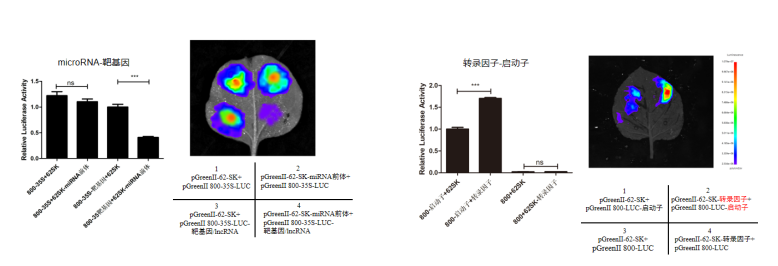
Dual-luciferase reporter assay is the core technical method for verifying gene transcriptional regulatory relationships and plays an irreplaceable role in the publication of high-level papers. The successful publication of this client of GeneCreate in 《Cancer Research》 not only reflects the client's scientific research strength but also reaffirms GeneCreate's solid technical foundation and service quality in the field of molecular interaction verification.
If you are conducting research such as transcription factor regulation, miRNA target verification, or promoter activity analysis, please feel free to contact GeneCreate for detailed solutions and quotes.