


Proteins are the executors of life activities and the interactions between proteins (Protein-Protein Interaction, PPI) constitute a complex "social network" with in cells.
Almost all biological processes from signal transduction to metabolic regulation rely on these intricate protein interaction networks. As Ren et al. (2024) pointed out in their review,the disruption of protein interaction networks is closely associated with various diseases and physiological abnormalities .
In the field of plant science with the completion of the whole-genome sequencing of model plants such as Arabidopsis thaliana and rice, analyzing the interactions between proteins has become an important topic in the post-genomic era. Understanding the processes of plant hormone signaling pathways (such as ethylene, auxin, gibberellin, abscisic acid), biological and abiotic stress responses, etc. all rely on an in-depth understan ding of protein-protein interactions.
Today, the bimolecular fluorescence complementation (BiFC) technique we are going to introduce is a powerful tool for studying plant protein interactions.
What is BiFC technology?
The principle of BiFC technology is very ingenious : a complete fluorescent protein (such as YFP ) is cut into two non - fluorescent fragments (N - terminal fragment and C - terminal fragment) at specific positions, and then fused and expressed with two target proteins (protei n A and protein B) to be studied respect ively.
Core mechanism:
• If protein A and protein B can interact with each other they will approach each other spatially
• This proximity enables the reassembly of two originally separated fragments of the fluorescent protein into a complete, f luorescently active protein
• By observing whether fluorescence signals appear under a fluorescence microscope , it is possible to determine whether there is an interaction between proteins
Common Fluorescent Protein Selection:
Venus/YFP: The most commonly used BiFC fluorescent protein, with strong fluorescence and low background sensitivity CFP /ECFP : Cyan Fluorescent Protein suitable for multicolor BiFC or FRET analysis in combination with YFP mCherry /mRFP : Red fluorescent protein with strong penetrability ,suitable for deep tis sue imaging .
Case Study: How to Verify Plant Protein Interactions with BIFC Technology?
Case 1: Unveiling the "Signal Code" of Arbuscular Mycorrhizal Symbiosis
Literature Name: Yeast two-hybrid-sequencing and bifluorescence complementation re sources for assessing protein-protein interactions in arbuscular mycorrhizal roots: CKL2 as a case study
Published Journal: New Phytol IF (8. 7)
Research Background: Arbuscular mycorrhizal (AM) symbiosis is an important interaction between plants and fungi. Through this symbiotic relationship, plants obtain mineral nutrients such as phosphorus while fungi obtain carbon sources from plants . This is one of the most common symbiotic relationships in nature, but the protein interaction network involved in this process is still unclear .
BIFC Experiment: The authors constructed a Y 2H library using the mycorrhizal roots of Medicago truncatula and Diversispora epigaea, and combined the Y2H-seq screening system with the BiFC vector system to conduct a case study on the CKL2 kinase.
Verification Results:
Y2H-seq screening identified three 14-3-3 proteins as the main interaction partners of CKL 2
The BiFC experiment confirmed the direct interaction between CKL2 and 14-3-3A protein at the periarbuscular membrane (PAM) position in the mycorrhizal root cells infe cted by Rhizophagus irregular is Preliminary functional verification was carried out using RNAi driven by the PT4 pr omoter.
When targeting all three members of 14-3-3A/B/C simultaneously, a decrease i n mycorrhizal colonization rate of about 31% was observed, suggesting that 14-3-3 proteins ha ve certain functions in AM symbiosis, but there is obvious functional redundancy among members
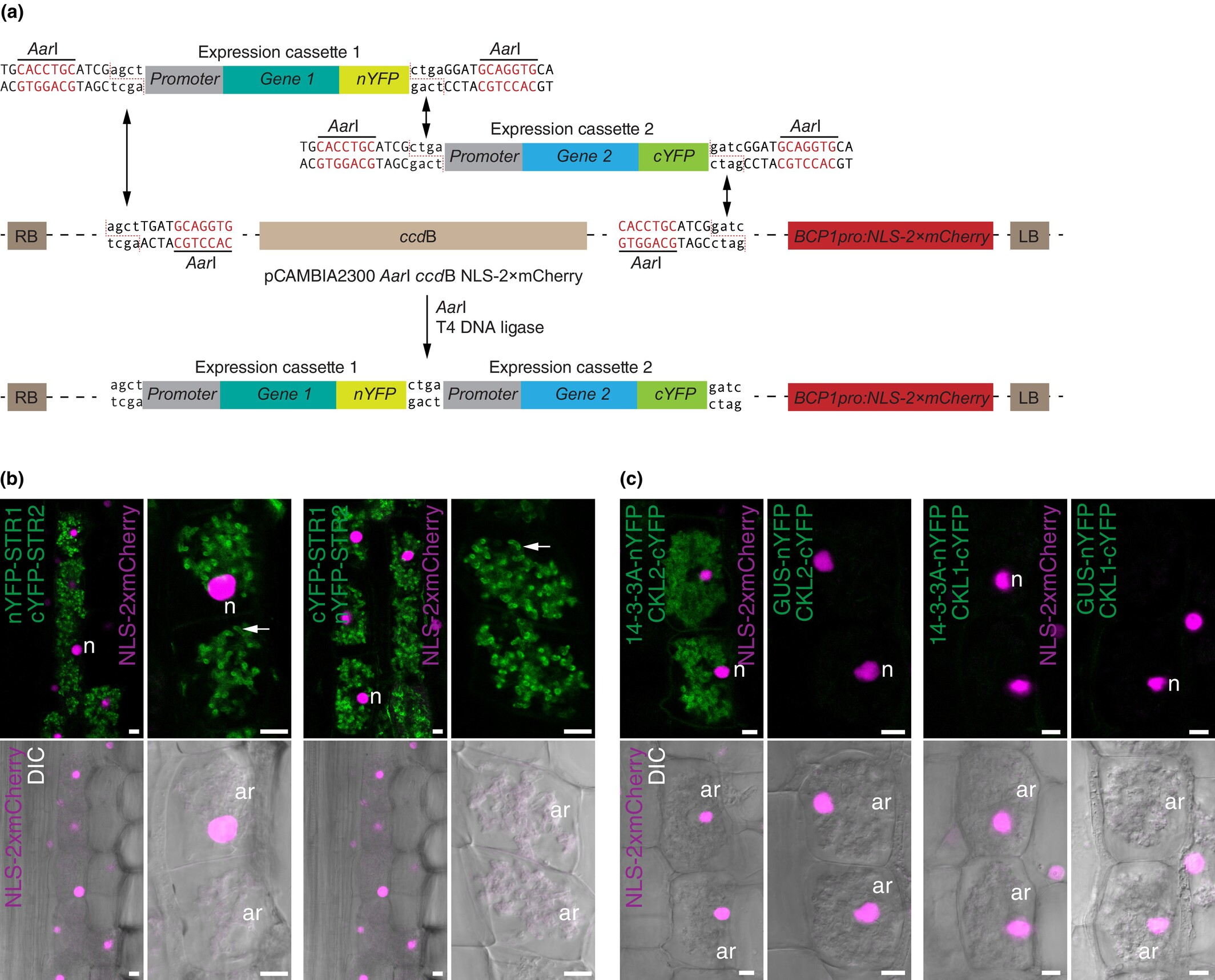
Highlight: The combined strategy of Y2H-seq and BiFC established in this study lai d a foundation for large -scale analysis of the symbiosis -related protein interaction network !
Figure 1. Detection of protein interactions in arbuscular mycorrhizal symbiosis in Medicago truncatula root cells using the bimolecular fluorescence complementation (BiFC ) system .
Case 2: How does auxin "inhibit" nicotine synthesis?
Literature source: Auxin-Induced Nicotine Inhibition Is Mediated by NaARF5 Through the Suppression of NaERF1-Like Expression and Interaction With NaERF1-Like in Nicotiana attenuata
Published journal: Plant Biotechnol J IF (12.8)
Research background: Auxin can strongly inhibit nicotine synthesis in tobacco, which is a typical case of plant hormone regulation of secondary metabolites . Nicotine is an important defensive alkaloid in tobacco and is toxic to insects. However, the s pecific regulatory mechanism has always been a mystery !
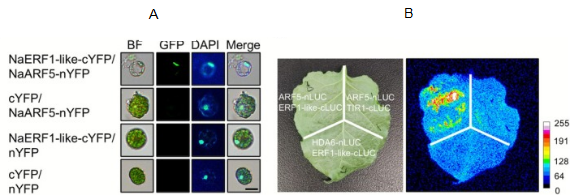
BIFC verification: The authors used yeast two-hybrid (y2H) screening to find that NaARF 5 (auxin response factor ) can interact with NaERF1-like (ethylene response transcription factor), and further verified this interaction by BiFC and luciferase complementation imaging (LCI ).
Verification results:
NaARF 5 and NaERF 1-like were found to interact through yeast two -hybrid screening
Both BiFC andLuciferase Complementation Imaging (LCI) experiments confirmed their direct binding in the nucleus
Mechanistic studies have shown that NaARF5 plays a dual inhibitory functi on: on the one hand, it inhibits the expression of the NaERF1-like gene at the transcriptional level; on the other hand, at the protein level, by physically interacting with NaERF1-like, it weakens its binding to and transcriptional activation ability of the promoters of key enzyme genes for nicotinesynthesis (such as NaPMT1.1, NaQP T2)
CRISPR-Cas9 knockout of NaARF5 led to a 1.6 - 2.5-fold increase in nicotine content, w hile overexpression significantly reduced nicotine accum ulation.
Highlights: This study not only clarified the molecular pathway of plant hormone regulation of secondary metabolism but also provided a theoretical basis and breeding targets for improving tobacco quality !
Figure 2. A: B iFC experiments demonstrated the interaction between NaARF 5 and
NaERF1-like proteins in vivo. B: LCI assays showed the interaction between NaARF5 and NaERF1-like in vivo
Case 3: The "molecular switch" for autophagosome-vacuole fusion
Literature source: The SNARE protein SYP22 in A rabidopsis interacts with ATG8 to promote the autophagosome-vacuole fusion
Published journal: Autophagy IF (18.6)
Research background: Cellular autophagy is an important mechanism for plants to r espond to stress (such as starvation, drought, pathogen invasion). The fusion of autop hagosomes with vacuoles is a key step in the autophagy process, determining the efficiency of autophagic degradat ion.
BIFC locks the key interaction: The authors used the BiFC technique to study the intera ction between the SNARE protein SYP22 and the autop hagy-related protein ATG8.
Verification results:
BiFC experiments confirmed tha t SYP22 and ATG8 have a direct interaction at the vacuolar membrane, and this interaction depends on three ATG8-interacting motifs (AIM s) in the N-terminal Habc domain of the SYP 22 protein .
This interaction promoted the fusion process of autophagosomes and vacuoles .
Genetic analysis showed that the loss of function of SYP 22 led to the accumulation of autophagosomes and affected autophagic flux.
Meanwhile, BiFC and co-immunoprecipitation (Co-IP) experiments also confirmed that SYP22 interacted with another SN ARE protein VAMP724, suggesting that they may form a trans-SNARE complex to mediate the fusion of autophagosomes with vacuoles .
Highlight: This study not only revealed a new function ofthe ATG 8 protein directly participating in autophagosome-vacuole fusion through interaction with SNARE proteins, but also provided a syp22 positive control material for protease K protection experiments in plant autophagy research!
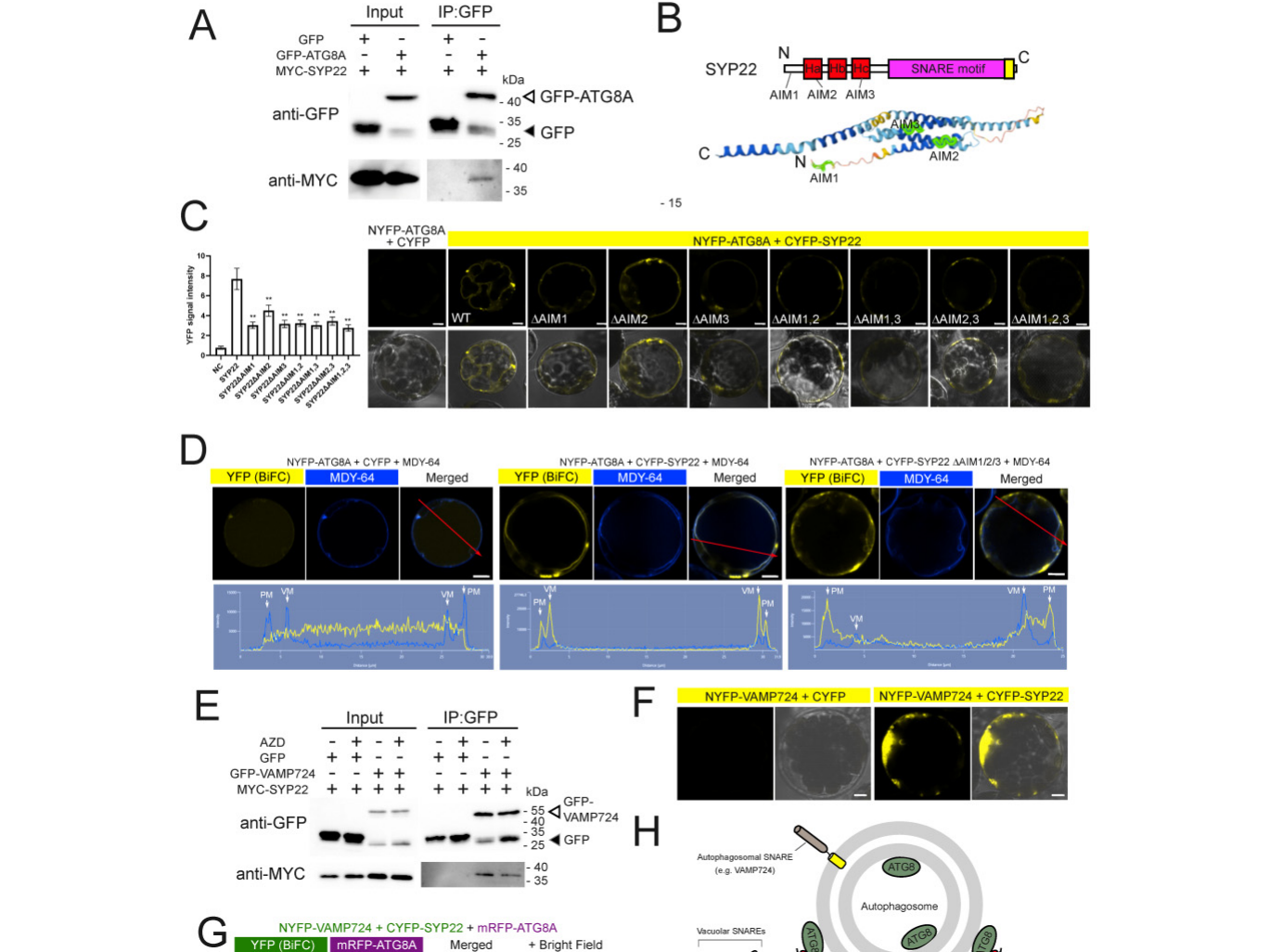
Figure 3. Co -IP and BiFC experiments demonstrated that SYP 22 interacted with ATG 8 and VAMP 724 respectively .
(A) Co-IP verified t he binding of SYP22 to ATG8A.
(B) The SYP22 structure contains three ATG8-bindin g motifs (AIMs).
(C-D) BiFC confirmed the interaction betw een ATG8A and SYP22 at the plasma membrane /vacuolar membrane and it is dependent on the AIM motif .
(E) Co-IP verified the bin ding between SYP22 and VAMP724.
(F-G) BiFC showed that when ATG8A is present, the interaction signal between SYP22 and VAMP724 increases, and it is localized around the ATG8A puncta.
(H) Model summary: As a SNARE component, SYP22 mediates the fusion of autophagosomes with va cuoles.
Golden rule: Multiple validations make the conclusion more reliable
As emphasized by Ren et al. (2024) in their review, the resul ts of a single method are often not persuasive enough. Researchers usually use multiple methods to validate each other and form a complete evidence chain:
|
Method |
Features |
Applicable Scenarios |
|
Yeast Two-Hybrid (Y2H) |
High-throughput screening of interacting partners |
Preliminary screening |
|
Bimolecular Fluorescence Complementation (BiFC) |
In vivo visualization of protein interactions |
Subcellular localization |
|
Luciferase Complementation Imaging (LCI) |
Sensitive quantitative detection |
Interaction strength analysis |
|
Co-immunoprecipitation (Co-IP) |
Biochemical validation of in vivo interactions |
Complex identification |
|
GST Pull-down |
In vitro validation of direct interactions |
Direct binding confirmation |
Recommended combination strategy:
1. Y2H screening: to discover po tential interaction partners
2. BiFC verification : to confirm interaction and local ization in living cells
3. Co-IP verification : to confirm the existence of complex at the bioch emical level
4. Genetic analysis : verification of the biological function of the interaction
Unique advantages of BIFC technology
1. "Real-time imaging" in living cells
Different from methods such as Co-IP that require cell lysis, BiFC can directly observe protein interactions in living cells, avoiding protein conformational changes or non-specific binding that may be caused by cell disruptio n.
2. "Precise navigation" of subcellular localization
The position of the fluorescence signal directly reflects the subcellular region where protein interaction occurs. For example, in the study by Ivanov et al. (2025), BiFC signals appeared around the periarbuscular membrane (PAM); w hile in the study by Yang et al. (2025), BiFC signals were located in the nucleu s.
3. High sensitivity for weak interactions
BiFC has high sensitivity to weak and transient interactions and can capture transient protein complexes that are difficult to detect by traditional methods.
4. Simple operation and high cost performance
Compared with the FRET technology that requires complex instruments, BiFC can be completed with only a conventional fluorescence microscope, with low experimental costs and a simple operation process.
5. A "universal tool" applicable to multiple species
The BiFC technology has been successfully applied to various plants such as Arabidopsis thaliana, rice, tobacco, and maize, showing broad applicability.
The development direction of the BiFC technology
1. Super-high-resolution imaging
Combined with super-resolution microscopy techniques ( such as STED, SIM), the fine structure of protein interactions can be observed at the nanoscale .
2. Dynamic tracking technology
Develop a photoactivatable BiFC system to achieve real -time tracking of the dynamic process of protein interactions .
3. High-throughput screening platform
Establish a high -throughput screening system based on BiFC for large -scale identification of protein interaction networks or screening of small molecule compounds that regulate protein interactions .
4. Multi-omics combined analysis
Combine BiFC with transcriptomics proteomics and metabolomics to deeply analyze the regulatory mechanism of protein interactions in biological processes .
By virtue of its unique advantages, BiFC has emerged as an indispensable tool for investigating protein–protein interactions in plants.
From arbuscular mycorrhizal symbiosis to hormone signal regulation and then to autophagy mechanism research the BiFC technology has been continuously promoting the development of plant science. With the continuous innovation and improvement of the technology, BiFC will play an even more important role in future plant research helping us uncover more mysteries of life .
The integrity of the technical platform and the maturity of the experimental system often determine the speed of research progress. Wuhan Kingcare Bioengineering Co., Ltd. has been deeply involved in the field of molecular interaction technology services for more than a decade and has established a coverage of bimolecular fluorescence complementation (BiFC), yeast two-hybrid (Y2H), luciferase complementation imaging (LCI), dual-luciferase reporter gene (Dual-LUC), co-immunoprecipitation (Co-IP), GST Pull-down, surface plasmon resonance (SPR), isothermal titration calorimetry (ITC), chromatin immunoprecipitation (ChIP), electrophoretic mobility shift assay (EMSA) and other more than a dozen mainstream mo lecular interaction detection platforms.
From project design, vector construction to experimental execution and data analysis, Ki ngcare provides a full-process one-stop technical service, and at the same time su pplies related experimental kits to meet all your needs from preliminary screening to final verificati on.
References
[ 1] Ivanov S, Müller LM, Lefèvre FM, Harrison MJ. (2025) . Yeast
two -hybrid -sequencing and bifluorescence complementation resources for assessing protein -protein interactions in arbuscular mycorrhizal roots : CKL 2 as a case study .
New Phytologist, 249: 1592-1604.
[2] Yang MY, Tong AH, Wang L, Wu JS. (2025). Auxin-Induced Nicotine Inhibition Is Mediated by NaARF 5 Through the Suppression of NaERF 1-Like Expression and
Interaction With NaERF 1-Like in Nicotiana attenuata . Plant Biotechnology Journal , 24: 2642-2656.
[3] Ren HM, Ou QS, Pu Q, et al. (2024). Comprehensive Review on Bimolecular Fluorescence Complementation and Its Application in Deciphering Protein -Protein Interactions in Cell Signaling Pathways. Biomolecules, 14(7): 859.
[4] Jung H, Ma W, Kim JH, Kwon C, Kang BH, Chung T. T he SNARE protein SYP22 in Arabidopsis interacts with ATG8 to promote the
autophagosome -vacuole fusion . Autophagy . 202 June 22(7):1503-1517.