


Newbies who just entered the lab are most afraid of their supervisor’s casual instruction like "Go and do an interaction experiment for verification." Interaction experiment? Which interaction experiment? With IP, CoIP, Pull down, RIP, and ChIP, when these five names are put together, just differentiating them can give you a headache.
Don’t panic. Although the names of these 5 experiments are all related to "precipitation", essentially they only answer two core questions: Which protein does a protein bind to? Which nucleic acid does a protein bind to? Today, let’s take a different approach. Instead of explaining them in the order of 12345, we will classify them according to "what you are looking for", and it will be easy to understand.
First, clarify a main line
According to the research object, these 5 experiments are divided into three major camps:
|
Type of interaction |
Experiments involved |
Core questions |
|
Protein-protein |
IP, CoIP, Pull down |
Protein searching for protein partners |
|
Protein-RNA |
RIP |
Protein searching for RNA partners |
|
Protein-DNA |
ChIP |
Protein searching for DNA fragments |
Among them, the concepts of IP, CoIP, and Pull-down are extremely easy to be confused. This article will focus on disassembling them; while RIP and ChIP correspond to protein-RNA and protein-DNA interactions respectively, and it is relatively simple to distinguish them.
1. IP (Immunoprecipitation)
Fish out the target protein alone
【Principle】
The core principle of IP technology: Specific antibodies are used to recognize soluble target protein antigens. The Fc segment of the antibody can be captured by Protein A or Protein G, thus anchoring the "target protein - antibody" complex on the solid-phase carrier of magnetic beads or agarose gel microspheres and separating it from the lysis mixture. After washing to remove non-specifically adsorbed miscellaneous proteins, the target protein is eluted and subsequent analysis is carried out.
【Put simply】
The cell lysate is like a social platform with thousands of "users". The antibody is a precise search engine that only recognizes one user ID - you enter the "account" of the target protein, and it locates this person and extracts the package together with his information.The magnetic bead is the "server" carrying this extraction, helping you to separately retrieve this user from the platform.
【Research purpose】
① Enrich and obtain the target protein from cell lysates;
② Enrich protein complexes to prepare for subsequent experiments (such as mass spectrometry to identify interacting proteins).
【Key features】
It only enriches the target protein and does not directly verify protein-protein interactions itself; however, if mass spectrometry is performed on the precipitated protein complex, potential interacting proteins can be screened, and controls are needed to exclude non-specific binding.
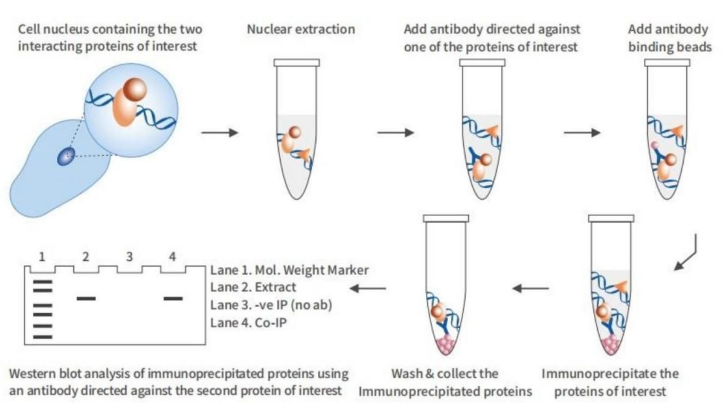
2. CoIP (Co-Immunoprecipitation)
Fish out a protein and verify its "partner"
【Core concept】
Precipitate A with an antibody against protein A. If A binds to protein B to form a complex in cells naturally, B will be pulled down "hitchhiking" with it. Then, detect B by WB to prove the interaction between A and B.
【Applicable Scenarios】
Verify whether there is an interaction between two known proteins in their natural state within cells - this is the gold standard for in vivo verification of protein-protein interactions.
【Key Warnings】
① Based on natural complexes within cells, the results are close to the physiological state and have high authenticity;
② Unable to distinguish direct interaction from indirect interaction - if A binds to C and C binds to B, B may also be pulled down, creating the false appearance of "direct A-B interaction".
③ Simple CoIP-WB can only verify the interaction of known proteins; combined with CoIP-MS using mass spectrometry, new interacting proteins can be discovered.
3、Pull-down
Prove "whether there is an interaction" in vitro
【Core Concept】
Fix a known protein (bait) on a solid-phase carrier, incubate it with a sample containing potentially interacting proteins, and the proteins that can directly bind (prey) are captured. After elution, their identities are determined.
【Applicable Scenarios】
① Verify whether two proteins "directly bind", excluding interference from indirect interactions;
② Screen for unknown proteins that bind to the bait protein from the lysate (in combination with mass spectrometry).
【Key Warnings】
① The in vitro environment is different from that within cells, and reasonable controls need to be set to exclude non-specific binding;
② Commonly used fusion proteins such as GST-tag and His-tag are used as baits, and it is necessary to ensure that the tags do not affect the natural folding and function of the proteins.
③ The interaction candidates obtained by pull-down are under in vitro conditions, and positive results still require intracellular experiments (such as ColP) to further verify the interaction under physiological conditions.
4. RIP (RNA Immunoprecipitation)
Protein finds its RNA partner
【Core concept】
Immunoprecipitate the protein with a specific antibody against the RNA-binding protein (RBP), and顺带 pull down the RNA bound to it, and then identify the RNA identity by RT-qPCR or sequencing.
【Applicable scenarios】
① Verify whether a known RNA binds to the target RBP;
② High-throughput screen all the RNAs bound by RBP in cells through RIP-seq.
【Key reminder】
① RNase activity must be inhibited throughout the process - once the RNA degrades, the experiment is in vain;
② IgG control and Input control must be set to ensure signal specificity.
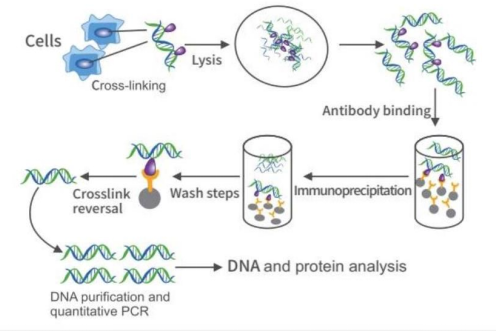
5. ChIP (Chromatin Immunoprecipitation)
Protein finds the DNA it regulates
【Core concept】
First, crosslink the protein-DNA complex in cells with formaldehyde to "freeze" it, and then break the chromatin into fragments of 200-500bp, and use
Immunoprecipitate the target protein antibody, and identify it by qPCR or sequencing after crosslinking and releasing DNA.
【Applicable Scenarios】
① Verify whether transcription factors or histones bind to specific DNA regions (such as gene promoters);
② ChIP-seq genome-wide screening of protein binding sites.
【Key Warnings】
① Crosslinking conditions and fragment size are the keys to success - excessive crosslinking makes it difficult to reverse crosslinking, and too large fragments result in decreased resolution;
② Must set Input control and IgG control.
Quick Decision Guide: Select the Right Experiment in Three Steps
Step 1: Determine the interaction partners
Protein vs Protein → Go to Step 2
Protein vs RNA →RIP
Protein vs DNA →ChlP
Step 2: Determine the verification purpose (protein-protein interaction)
Prove whether two known proteins interact in vivo →ColP
Prove whether two proteins directly bind (in vitro) →Pull down
Just enrich the target protein itself / Prepare for mass spectrometry screening →IP
Step 3: Determine whether high-throughput screening is required
Known target nucleic acid sequence →qPCR verification
Want to screen at the whole genome/whole transcriptome level →ChlP-seq / RIP-seq
One-sentence formula
IP captures proteins, CoIP brings out partners,
Pull down verifies direct interaction, RIP captures proteins and pulls down RNA, ChIP crosslinks and locks DNA.
Next time your supervisor asks you to "do an interaction experiment", first ask yourself two questions: Who’s interaction do I want to study? In vivo or in vitro verification? Once you have the answers, the experiment is set.