


Before verifying whether two proteins bind to each other, do not rush to select experiments. First clarify the question you intend to answer: Do they exist in the same complex inside cells? or Can they bind directly? The former is addressed by Co-IP, and the latter by GST Pull-down.
Many researchers wonder which assay is more reliable, but this is in itself a false premise. Co-IP and GST Pull-down do not provide evidence at the same level. A positive Co-IP result only indicates that two proteins reside within the same complex in cells. Co-IP cannot distinguish whether the proteins make direct contact or are bridged by a third-party protein. Therefore, it only proves co-precipitation rather than definitive direct interaction. Likewise, a negative GST Pull-down result does not prove that the proteins do not interact in cells. The in vitro system lacks post-translational modifications, transient weak interactions and other physiological factors present in living cells.
Interpreting results from different assays at the same evidentiary level is one of the most common pitfalls in protein interaction validation. Below we break down what each assay can and cannot demonstrate.
I. The two assays answer distinct scientific questions
Co-IP detects the association of protein complexes in the cellular context. After cell lysis, endogenous proteins and their complexes are preserved. An antibody is used to capture the bait protein, and prey proteins that bind to the bait or belong to the same complex are co-precipitated. Detection of the prey protein in the precipitate indicates that the two proteins are part of the same complex inside cells.
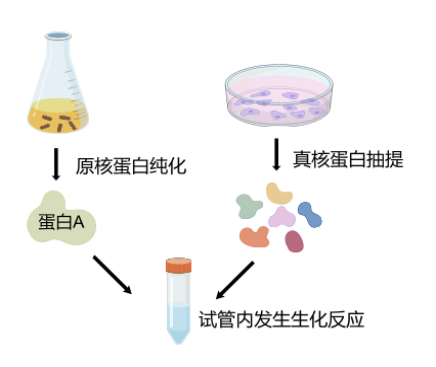
GST Pull-down detects direct molecular binding in vitro. The tagged bait protein is immobilized on an affinity matrix and incubated with purified prey protein in an in vitro buffer system. After washing, the matrix is examined for retained prey protein. This system is free of contaminating cellular proteins, scaffold proteins and adaptor proteins. A positive result supports direct binding between the two proteins in vitro.
The difference between them does not lie in sensitivity or success rate, but in the type of evidence generated. Co-IP provides evidence of physiological association within cells, while Pull-down provides evidence of direct binding under in vitro conditions. Neither assay alone can cover all required information.
II. Limitations of Co-IP: belonging to the same complex is not equivalent to direct binding
The inherent limitation of Co-IP is methodological and independent of experimental quality. Most cellular proteins function as components of complexes, and lysates contain abundant contaminating proteins, scaffolds and adaptors. When the bait protein is enriched, all proteins within its complex are co-purified, including both directly binding partners and indirectly associated proteins linked via third-party mediators. For this reason, a positive Co-IP result only confirms co-complex localization and cannot rule out bridging by other proteins; it cannot serve as proof of direct interaction.
Co-IP can be divided into two categories based on the source of bait protein, with different evidentiary weight:
- Endogenous Co-IP: No exogenous plasmids are transfected. It detects interactions between natively expressed endogenous proteins, preserving physiological conditions, native protein abundance and post-translational modifications. Its drawbacks include dependence on antibody specificity and difficulty detecting low-abundance proteins.
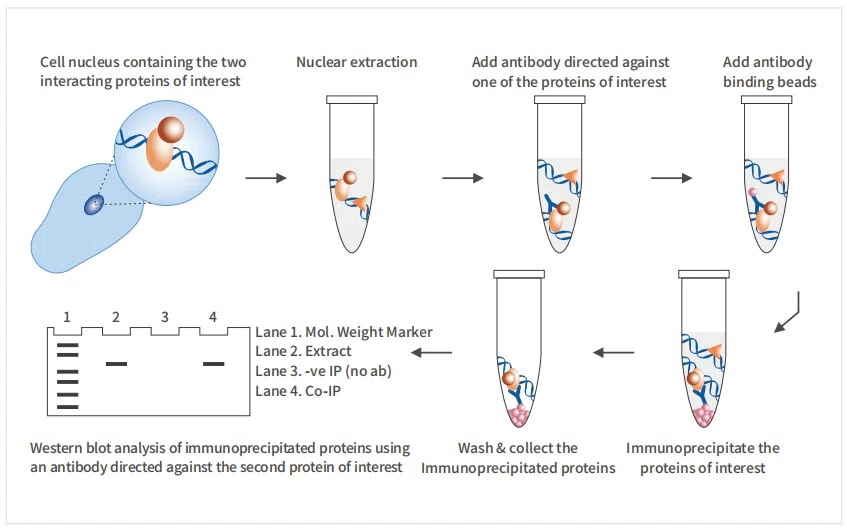
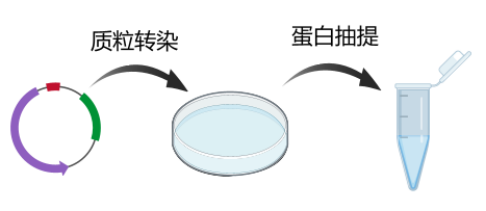
- Exogenous Co-IP: Exogenous tagged plasmids are transfected to overexpress the bait protein, which is enriched using tag-specific antibodies. It generates strong signals and has a high success rate, commonly used for preliminary screening and initial validation. However, exogenous overexpression disrupts the native stoichiometry of cellular proteins and may cause non-specific false-positive interactions. A positive exogenous Co-IP result is only preliminary evidence. To support the conclusion of interaction under physiological conditions, cross-validation with endogenous Co-IP or Pull-down is required.
III. GST Pull-down: binding in vitro does not guarantee interaction in cells
To understand the limitations of GST Pull-down, we first consider its core advantage: a clean in vitro system. The incubation mixture contains no cellular contaminants, scaffold or adaptor proteins, eliminating the possibility of third-party bridging. This is exactly the information gap that Co-IP cannot fill.
Nevertheless, GST Pull-down has clear boundaries. The in vitro environment differs from that inside living cells, lacking post-translational modifications, macromolecular crowding effects and physiological protein concentrations. A positive Pull-down result only demonstrates that the two proteins are capable of direct binding under defined in vitro conditions and cannot be directly extrapolated to confirm that this interaction occurs in cells. Conversely, a negative Pull-down result does not disprove cellular interaction; the negative outcome may arise from incompatible in vitro conditions rather than an intrinsic inability of the proteins to bind.
IV. Construction of an evidence chain: combination rather than substitution
The limitations of the two assays complement each other. Co-IP addresses whether proteins form a complex in cells, and Pull-down addresses whether they can bind directly in vitro. A complete evidence chain for protein interaction usually combines both: Co-IP confirms the existence of the complex in cells, and Pull-down supports that this association can be direct.
Experimental design can be tiered according to evidentiary strength:
| Question to be answered | Suitable assay | Evidentiary positioning |
|---|---|---|
| Are there indications of protein interaction? | Exogenous Co-IP | Preliminary screening, requires cross-validation |
| Do the proteins form a complex in cells? | Endogenous Co-IP | Physiological association evidence |
| Is the interaction direct? | GST Pull-down | In vitro direct-binding evidence |
| Both physiological existence and direct binding are validated | Co-IP combined with GST Pull-down | Complete evidence chain |
V. Common misapplications
- Drawing a conclusion of direct binding solely from a positive Co-IP result while ignoring the possibility of bridging by a third protein within the complex.
- Treating a positive exogenous Co-IP result as conclusive without considering non-specific binding induced by overexpression.
- Using a negative Pull-down result to reject cellular interaction, ignoring the absence of modifications and cofactors in the in vitro system.
- Missing proper controls: Co-IP requires an isotype IgG control, and Pull-down requires an empty-tag or blank matrix control. Positive results without adequate controls are weak and unconvincing.
No single assay can fully characterize protein interactions. Co-IP and Pull-down are not competing alternatives ranked by performance; they answer questions at different levels. Experimental design should start with defining the scientific question: whether the proteins associate within cells, or whether they bind directly in vitro. The complementary assay is then used to fill gaps in interpretation. Mixing evidence from different dimensions is a major source of invalid conclusions.
Rigorous interaction validation often requires multiple orthogonal assays: from Co-IP for complex association, to GST Pull-down for in vitro direct binding, and further approaches for transient weak interactions or structural characterization.
For diverse protein interaction studies, GeneCreate provides one-stop solutions for molecular interaction research. Our platform supports more than ten mainstream and cutting-edge technologies including Co-IP, GST Pull-down, BiFC, SPR, MST and ITC. From classic co-immunoprecipitation and in vitro protein purification to real-time kinetic binding analysis, we deliver high-quality experimental services and help you rationalize experimental design to build robust evidence chains. Entrust your protein interaction validation to us, and produce conclusions that stand up to scrutiny.